

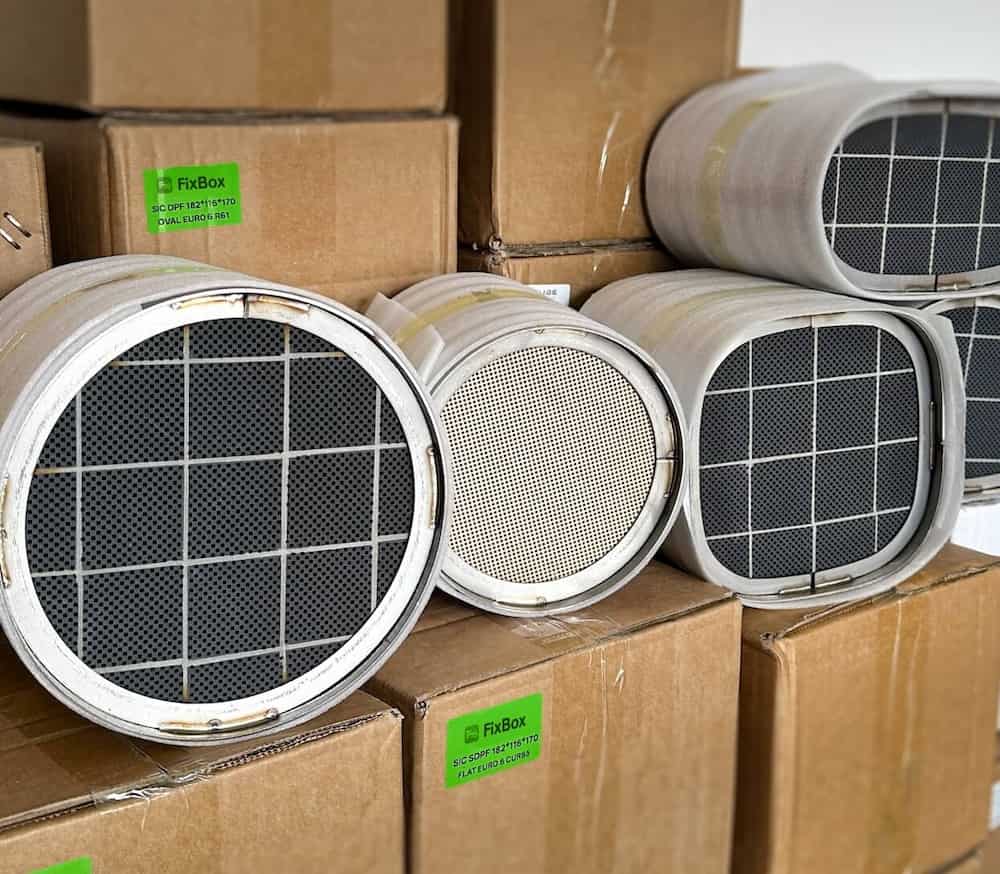
DPF Cleaning & Repair
DPF Filter Cleaning and DPF Repair – Professional Solution With Warranty | FixBox DPF Service
DPF filter cleaning and professional DPF filter repair are the speciality of FixBox DPF Service Sarajevo. FixBox d.o.o. is a workshop specialised in diagnosing and solving every problem with the DPF system on vehicles of all categories, with warranty. Our DPF cleaning is performed on a machine that is unique in the region and does not damage the DPF filter core. Customers come to us from all over Bosnia and Herzegovina, as well as from Germany, Austria and Slovenia, for high-quality and affordable DPF filter cleaning in Sarajevo.
Machine DPF Cleaning Without Damaging the Filter
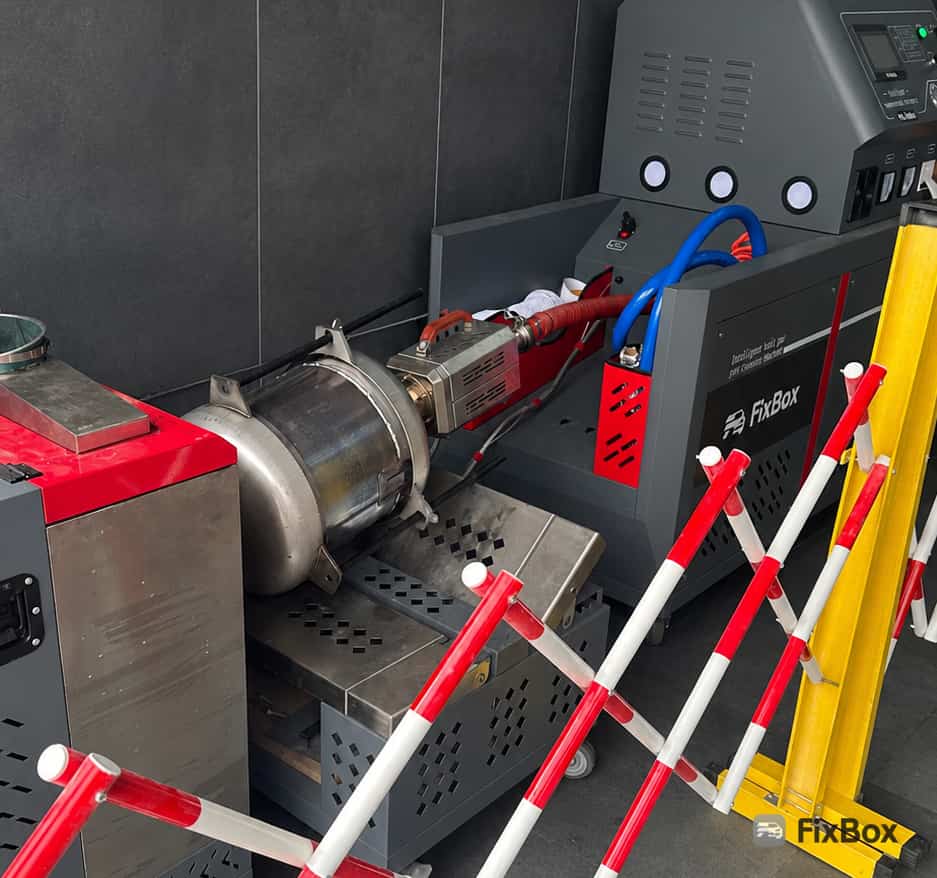
Unlike conventional water-based DPF washing systems, which can erode the ceramic and strip precious metals from the DPF, our system uses controlled high temperature and a powerful air flow.
The DPF regeneration process takes place under strictly controlled conditions:
- high temperature to burn off soot,
- high air flow to remove ash,
- intelligent control of the DPF cleaning process.
This method removes up to 99% of the soot and ash from the DPF filter without damaging its structure.
Every customer receives:
- photos of the DPF filter before and after cleaning,
- a back-pressure measurement of the DPF before and after the process,
- a warranty on the DPF cleaning performed.
How Does a DPF Filter Work and What Is Regeneration For?
A DPF filter (Diesel Particulate Filter) traps soot particles from a diesel engine’s exhaust gases. As soot accumulates, the filter gradually fills up and must be cleaned periodically through a process called DPF regeneration, which the vehicle’s engine electronics monitor and trigger automatically once the soot level – that is, the differential pressure across the DPF – exceeds a certain threshold. During regeneration the accumulated soot burns off at high temperature and turns into fine ash, which restores the filter’s flow and lowers the differential pressure across the DPF.
Regeneration happens in three ways, depending on the driving style and the condition of the vehicle:
- Passive regeneration – happens on its own during longer drives on open roads or the motorway, when the exhaust gas temperature is high enough (300°C–400°C) to burn off the soot without any intervention.
- Active regeneration – when the temperature is not sufficient (e.g. in city driving), the control unit (ECU) injects extra fuel to raise the exhaust temperature (600°C–700°C) and start burning the soot.
- Forced (service) regeneration – when the vehicle cannot regenerate the filter on its own, we trigger a forced regeneration with a diagnostic tool at the workshop, under strictly controlled conditions.
If regeneration is frequently interrupted or the filter becomes too clogged, soot and ash accumulate to the point where machine DPF filter cleaning is required.
How the DPF System Works – From Engine to Exhaust
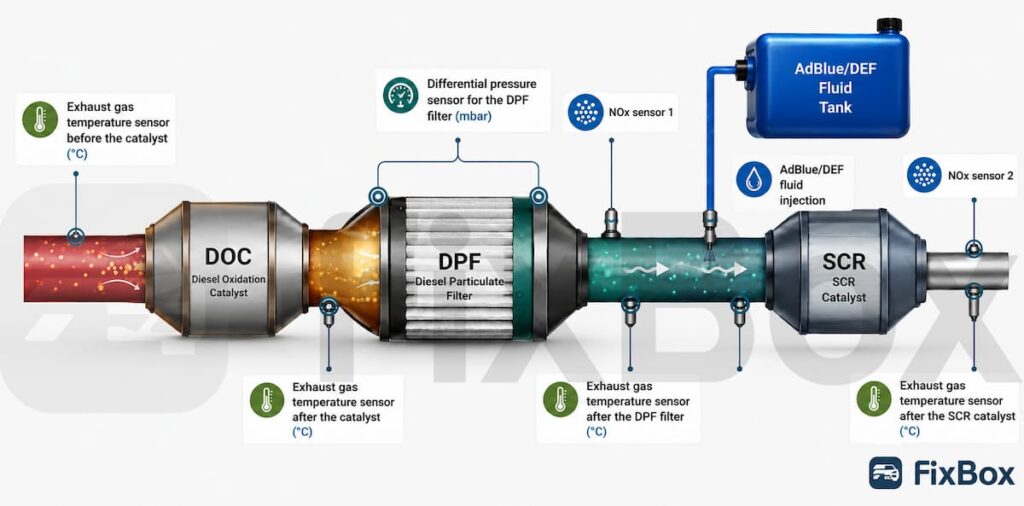
The illustration below shows the path of exhaust gases through the emission system of a modern diesel engine. Here is how each part works, in order:
- Exhaust gases from the engine – produced by the combustion of diesel fuel and entering the vehicle’s emission system.
- DOC – Diesel Oxidation Catalyst – raises the exhaust gas temperature and oxidises harmful substances such as carbon monoxide (CO) and unburned hydrocarbons (HC).
- DPF filter – captures and retains soot (solid diesel particles). It carries a differential pressure sensor that measures the pressure difference before and after the filter, so the engine control unit (ECU) knows how clogged the DPF is and when to start regeneration.
- AdBlue injection – an injector sprays AdBlue (urea) into the exhaust stream. On the SCR catalyst, urea neutralises harmful nitrogen oxides (NOx) and converts them into harmless nitrogen and water vapour. (In some models the DPF and SCR are combined into a single element – then there is only a DOC catalyst and a DPF with an SCR coating, known as an SDPF.)
- NOx sensors – located before and after the SCR catalyst, they measure the NOx concentration. By comparing the difference (NOx before vs after), the system checks the efficiency of the AdBlue/SCR system.
Why Does a DPF Filter Get Clogged?
A DPF filter does not clog for no reason – behind clogging there is almost always a driving style or a fault that prevents normal regeneration. The most common causes of DPF filter clogging are:
- city and short-distance driving (start-stop) – the engine never reaches operating temperature, so regeneration does not start or is constantly interrupted,
- a faulty differential-pressure sensor or exhaust temperature sensor – the ECU receives incorrect data and does not trigger regeneration in time,
- a faulty glow element or a leaking EGR valve,
- a bad or faulty injector that injects too much fuel and creates more soot,
- a turbocharger leaking oil into the exhaust system,
- false (unmetered) air due to a cracked hose or a bad gasket,
- the wrong engine oil (oil that is not low-SAPS specification produces more ash).
That is why, before every cleaning, we run diagnostics – so we remove the cause, not just the consequence. Otherwise the DPF filter would clog again.
How to Recognise a Clogged DPF Filter?
If you notice the following symptoms, there is a high probability that the DPF filter is clogged or not working properly:
- an illuminated Check Engine or DPF warning light
- loss of engine power
- the vehicle goes into limp mode (safety mode)
- increased fuel consumption
- frequent or failed DPF filter regeneration
Soot and Ash – What Is the Difference?
Many people think a clogged DPF filter is always full of soot, but there is an important difference:
- Soot is produced by fuel combustion and can be burned off during regeneration.
- Ash is a residue that regeneration cannot remove – it accumulates permanently in the filter over the years.
It is precisely because of ash that no regeneration (passive, active or forced) can keep a DPF filter clean forever. When too much ash accumulates, only machine DPF filter cleaning can physically remove the ash and return the filter to proper condition.
On-Car DPF Filter Cleaning
When diagnostics show that the DPF filter is only mildly clogged, we perform DPF cleaning directly on the car, without removal. We use our own branded chemistry from the German chemical industry.
This DPF cleaning method is ideal for preventive maintenance and mild DPF clogging.
- no DPF filter removal,
- shorter service time,
- a safe procedure without damaging the DPF core.
DPF Filter Problems We Solve
At FixBox we solve all kinds of DPF problems, including:
- clogged DPF filter
- DPF blocked by ash and soot
- cracked or melted DPF
- differential-pressure faults
- failed or frequent regenerations
- increased fuel consumption due to DPF problems
- loss of engine power
- illuminated DPF or Check Engine light
- rising oil level caused by regeneration
- SCR, AdBlue and catalytic converter problems
If you have any of these symptoms or problems, we recommend timely diagnostics and professional DPF filter cleaning so you can avoid more expensive failures.
Benefits of a Properly Working DPF System
After proper DPF filter cleaning or repair you get:
- No black smoke from the exhaust
- Clean exhaust with no soot
- Exhaust emissions compliant with legal standards
- Safe travel to EU countries with no problems at the border
- Passing the roadworthiness test without difficulty
- Proper engine operation and optimal fuel consumption
- A longer lifespan for the turbo system and EGR valve
A properly working DPF filter means a safer, more environmentally friendly and technically compliant vehicle.
Professional DPF System Diagnostics – Not Just Reading Fault Codes
Before every cleaning or repair of DPF, GPF, CAT, SCR – AdBlue, we run complete diagnostics using the most modern, original authorised diagnostic equipment:
- monitoring of all engine operating parameters,
- measuring and validating sensor signals,
- analysing regeneration data,
- checking the CAT, GPF, SCR and AdBlue systems.
We Service All Types of DPF, GPF, CAT, SCR (AdBlue) Systems
- DPF filters for passenger vehicles (GPF, CAT, SCR – AdBlue)
- DPF filters for vans (CAT, SCR – AdBlue)
- DPF systems on trucks and commercial vehicles (CAT, SCR – AdBlue)
DPF Filter Cleaning Price in Sarajevo
The most common question we get is: how much does DPF filter cleaning cost?
The price depends on the type of vehicle, and machine cleaning starts from 220 KM (approx. €110). In most cases, professional machine cleaning is many times cheaper than replacing the DPF filter with a new one.
In addition to cleaning, we also offer DPF filter repair at a significantly lower price than buying a new filter.
For the exact price of DPF filter cleaning or repair in Sarajevo, contact FixBox.
Most Common DPF Fault Codes
- P2002 – DPF efficiency below threshold
- P2463 – soot accumulation
- P242F – ash accumulation
DPF Cleaning for Popular Vehicle Models
- DPF cleaning VW Golf 6, Golf 7
- DPF cleaning Passat B6, B7, B8
- DPF cleaning Audi A3, A4, A5, Q5
- DPF cleaning BMW, Mercedes, Škoda, Ford, Peugeot, Citroen, Fiat, Hyundai
Can You Drive With a Clogged DPF Filter?
In the short term the vehicle will run, but driving with a clogged DPF filter is not recommended. The vehicle usually goes into limp mode (safety mode with reduced power), fuel consumption rises, and continuing to drive can lead to overheating and cracking of the DPF filter, turbo failure or fuel diluting the engine oil. As soon as a DPF warning light or a loss of power appears, we recommend timely diagnostics and cleaning to avoid a more expensive repair.
DPF Delete and Removal – Why It Is Not a Solution
Removing (gutting) the DPF filter and software deletion (DPF delete) is illegal and carries serious consequences: the vehicle fails the roadworthiness test and TÜV, emits significantly more harmful particulates, and can run into problems at the border when entering EU countries. On top of that, removing the DPF lowers the vehicle’s value.
At FixBox we do not perform DPF deletes – we offer legal solutions: professional DPF filter cleaning, and when the core is damaged, DPF filter repair by installing a new core. This keeps the vehicle environmentally compliant and able to pass the roadworthiness test.
Frequently Asked Questions (FAQ)
How much does DPF filter cleaning cost?
If you are wondering how much DPF filter cleaning costs, the price at FixBox starts from 220 KM (approx. €110) for machine cleaning.
How long does DPF filter cleaning take?
The process usually takes a few hours, depending on the filter’s condition. The cleaning itself takes 1 to 2 hours, and for machine cleaning the removal and refitting take an additional 1 to 6 hours.
Can a DPF be cleaned without removal?
There are chemical cleaning solutions, but professional machine cleaning delivers the best results.
Can you drive with a clogged DPF filter?
Short-term yes, but it is not recommended – the vehicle goes into limp mode, consumption rises, and continued driving can crack the DPF filter. Timely cleaning is recommended.
What is the difference between soot and ash in a DPF filter?
Soot can be burned off during regeneration, while ash accumulates permanently and can only be removed by machine DPF filter cleaning.
DPF Cleaning or Repair – Which to Choose?
In most cases a DPF filter can be successfully cleaned. However, if the filter is mechanically damaged, cracked or melted, the only solution is DPF filter repair.
If your DPF is mechanically damaged, cracked or melted, see in detail how we perform DPF filter repair by installing a new core – including the price, the procedure and how to recognise a cracked DPF.
Do you solve AdBlue and SCR system problems?
We solve all kinds of problems on vehicle emission systems (EURO 6) – see our AdBlue and SCR service. For example, the AdBlue “no restart in 1000 km” fault and its P204F00 solution.
What the Abbreviations Mean (DPF, GPF, SCR, CAT, ASC, AdBlue)
- DPF – Diesel Particulate Filter
A system that traps and burns off soot from a diesel engine’s exhaust gases. - GPF – Gasoline Particulate Filter
Similar to the DPF system, but intended for direct-injection petrol engines. - CAT – Catalytic Converter
A device that uses chemical reactions to reduce the amount of harmful gases, converting them into less dangerous compounds. - SCR – Selective Catalytic Reduction
A system that uses AdBlue fluid to reduce harmful NOx gases in the exhaust systems of diesel engines. - AdBlue – Diesel Exhaust Fluid (DEF)
A special urea-based fluid injected into the SCR system to reduce harmful gas emissions. - ASC – Ammonia Slip Catalyst
An additional catalytic element in the SCR system that prevents excess ammonia from escaping into the atmosphere.
Why FixBox Is the Best Choice for DPF Filter Cleaning in Sarajevo
- a workshop specialised in DPF systems
- original diagnostics
- warranty on the work
- fast service
- hundreds of successfully solved cases
Book Your DPF Service at FixBox DPF Service Sarajevo
If you have a problem with a clogged DPF filter, frequent regenerations or a loss of power, turn to the DPF experts in Sarajevo.
Our DPF filter cleaning service in Sarajevo uses state-of-the-art equipment and provides a warranty on the work.
FixBox d.o.o. Sarajevo – your reliable towing service and vehicle workshop.